
pla·gia·rism
noun
the cardinal sin of the academic world
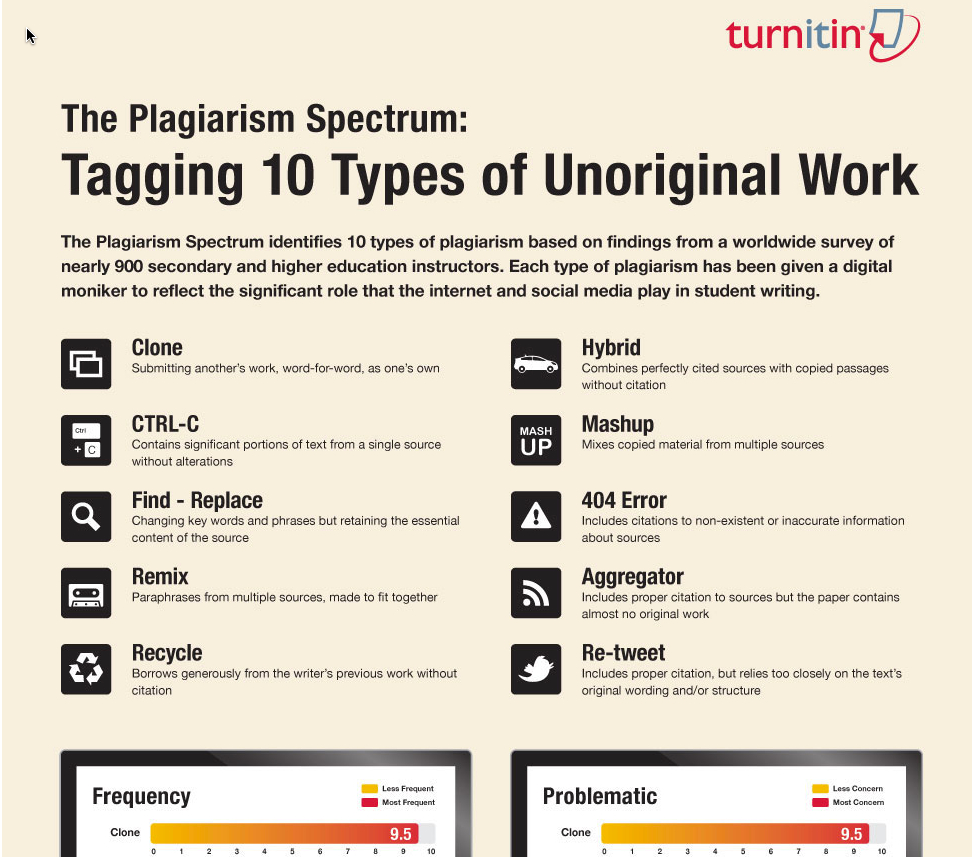
Start by looking over TurnItIn.com’s “Plagiarism Spectrum: Tagging the 10 Types of Unoriginal Work.”
Then watch Bainbridge State College’s “Plagiarism: How to avoid it” for a brief discussion of the main types of plagiarism.
Review by watching WriteCheckVideos’ discussion of the ten types of plagiarism that are used on the TurnItIn.com Plagiarism Spectrum infographic.
Finally, see if you can identify the following TED-Ed plagiarism examples by their TurnItIn.com Plagiarism Spectrum titles.
Click here for the full lesson at ed.ted.com: http://ed.ted.com/lessons/the-punishable-perils-of-plagiarism-melissa-huseman-d-annunzio
Artificial Intelligence & generative Technologies
“The use of words, ideas, images, and multimedia that are not your own, including those produced by generative and emerging technologies, must be appropriately attributed. Unattributed or improperly attributed use of words, ideas, images, and multimedia that are not your own, including those generated by emerging technology such as Artificial Intelligence (AI), constitutes plagiarism. Individual disciplines, professors, courses, and even assignments may permit, partially permit, or not permit the use of AI or other tools, and you are responsible for following the specific guidelines in each instance. If you have any questions about usage, please ask your professor” (Nelson University, Student Handbook’s Academic Integrity Statement, 2025-2026).
If ChatGPT or other generative AI tools are used at any stage of the writing process, attribution to the tool and its role must be given. Treat the program as the author, the company who makes the program as the publisher, include the date that the tool was used and the URL where the tool can be found. Additionally, include a paragraph in the body of the assignment or in a footnote that explains exactly how AI was used.
In summary, if AI is used in any course work, 1) cite the AI as in the following examples, and 2) also include a paragraph in the body or in footnotes that explains exactly how AI was used.
Unattributed use of AI in any course work is considered plagiarism and is subject to the plagiarism policy of the class.
Footnote: 1. ChatGPT, response to “Who is my neighbor?” OpenAI, February 29, 2024. https://chat.openai.com/chat.
Short Note: 3. ChatGPT, “Neighbor,” Feb 29, 2024.
Bibliography: ChatGPT. OpenAI. February 29. 2024.
For further guidance on plagiarism, see:
- Plagiarism.org, sponsored by WriteCheck, which is owned by iParadigms, the same company that owns TurnItIn.com.

- The Purdue Online Writing Lab (OWL) series on “Avoiding Plagiarism.”
- The MIT series on “Citing Your Sources.” The discussion of “Common Knowledge” is one of the clearest discussions of what constitutes common knowledge and would therefore not need to be cited.


2 thoughts on “Plagiarism”